Lucie Holá
Wedding Ceremony Options
Religious, Civil or Symbolic?
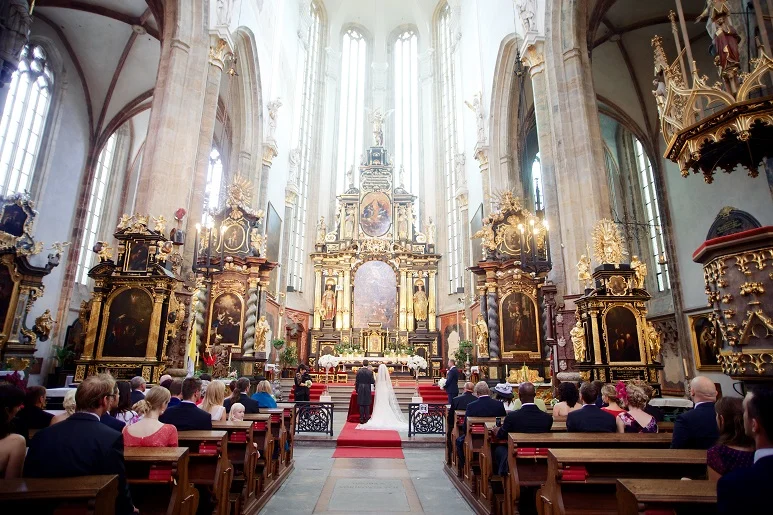
One of the most important moments of the entire wedding day — and one you simply cannot do without — is the wedding ceremony itself. There are plenty of beautiful places to hold a ceremony. Prague, in particular, offers a wide variety of gardens, palaces, beautifully decorated rooms, terraces and churches. But the fundamental question is: what kind of ceremony do you actually want? I’ll try to explain the different options available in Prague and throughout the Czech Republic.
RELIGIOUS CEREMONY IN A CHURCH
If you are both practising Roman Catholics, you probably already have a fairly clear idea of where your ceremony will take place.
Traditionally, the wedding is held in the home parish of one of the partners. If you are planning to marry in a church outside your parish, you will probably need permission from your home parish.
If you would like your own priest to conduct the ceremony rather than the priest responsible for the church where the wedding will take place, you will probably also need permission from the priest authorised to officiate there.
Naturally, neither partner should be divorced. If one of you has been divorced, this can present a problem for the Catholic Church and may need to be resolved through the Vatican.
If one partner is Catholic and the other belongs to another Christian denomination, such as an Evangelical or Protestant church, it may be necessary to request a dispensation from the appropriate bishop, depending on the church where you wish to marry.
This should not necessarily prevent the marriage, but the process can be rather complicated and uncomfortable.
According to the clergy, the couple should also discuss and agree on which faith they intend to practise together, which faith their children will be brought up in and how religion will form part of their married life.
The official documents are handled through the local registry office, which issues a Certificate for a Religious Marriage. This certificate must not be more than three months old.
In addition to this certificate, the church will require other documents, such as:
-
Baptism certificates, also no more than three months old
-
Birth certificates
-
Confirmation that you have completed marriage preparation
-
Where applicable, a certificate of legal capacity to marry
-
Identity cards
If one partner was baptised outside the Catholic Church, or has not been baptised at all, it will be necessary to apply to the bishop’s office for a dispensation — permission to marry a non-Catholic.
RELIGIOUS CEREMONY OUTSIDE A CHURCH
There is also a way to have a religious wedding ceremony outside a church, without relying on a parish priest or a civil registrar to conduct the ceremony.
For example, the registry office may simply be unwilling or unable to attend your chosen venue at your preferred date and time. Or perhaps you would like a more personal and longer ceremony than the standard civil option.
Catholic priests are generally not willing to conduct wedding ceremonies anywhere other than a church.
However, within Evangelical and Protestant churches, there are exceptions. Some authorised officiants are happy to travel to almost any location.
There are various churches and religious communities, such as the Evangelical Church of Czech Brethren, the Unitarian Church, the Church Without Borders and the Czechoslovak Hussite Church.
These churches have ministers, priests or pastors who are legally authorised to conduct marriages.
The great advantage of this option is their flexibility. They are often willing to conduct a wedding ceremony almost anywhere and at almost any time.
You can meet with your officiant several times before the wedding to discuss the structure of the ceremony, what you would and would not like to include, readings by family members or friends, the wording of your vows and much more.
This option is ideal for couples who have not been baptised, or where only one partner has been baptised, and who do not want a civil registrar to conduct their ceremony.
However, most religious officiants conduct ceremonies wearing their religious robes. Only a few are willing to wear a suit instead. Some couples may see this as a disadvantage, while others may appreciate it.
Some officiants prefer to meet you several times before the wedding, while others are happy with just one or two meetings to get to know you.
They typically charge around CZK 6,000 for conducting the ceremony, part of which is paid to their church.
All official documents are handled through the registry office.
You will need to obtain a Certificate for a Religious Marriage, which must not be more than three months old, and give it to your officiant.
After the ceremony, the officiant issues a marriage record, which you must take to the registry office as soon as possible.
The registry office then uses this document to issue your marriage certificate.
CIVIL WEDDING CEREMONY
This is probably the simplest and most common way to get married in the Czech Republic.
To reserve a date, you simply need to telephone the registry office or visit in person.
Dates for the following year are usually released in November, although some registry offices open their bookings later.
In Prague, popular dates tend to fill up very quickly. If you cannot secure your preferred date, you may need to consider an alternative church officiant or a symbolic ceremony.
One of the advantages of a civil ceremony is that neither partner needs to be baptised, divorced individuals can marry, and the ceremony itself is relatively short.
However, some couples may see the short duration — or rather, the speed — as a disadvantage.
Civil ceremonies can sometimes feel impersonal and rushed, without personal vows or other meaningful elements.
Unfortunately, you often do not even know who will be conducting your ceremony, whether they will agree to use the microphone you have prepared or what their speech will be like.
Nevertheless, this remains one of the simplest and most affordable options.
The disadvantage is that registry office officials are not willing or able to conduct ceremonies at any location or time you choose.
SYMBOLIC WEDDING CEREMONY
Symbolic wedding ceremonies have become increasingly popular in recent years, particularly among international couples.
For example, both partners may hold multiple nationalities, have temporary residence in a country different from their permanent residence, or one or both may have been previously married.
The amount of paperwork required for a legal wedding in the Czech Republic can be considerable.
You may need to obtain various certificates confirming your marital status and residence, a certificate of legal capacity to marry, proof of citizenship and other documents.
If you live in a different country from the one where you need to obtain these documents, the process can become extremely demanding.
It is often easier to get legally married in the country where the administrative process is simplest, rather than arranging all the paperwork for the Czech authorities and then dealing with further formalities in another country after the wedding.
In this situation, a symbolic ceremony can be a wonderful and much more enjoyable solution.
A symbolic officiant is often an actor or professional celebrant who is happy to conduct the ceremony exactly according to your wishes and requirements.
They will meet with you beforehand and create a ceremony tailored specifically to you.
Many are willing to conduct the ceremony in several languages or work extremely well with an interpreter.
The result can be a truly beautiful, personal and carefully designed wedding ceremony.
Your guests may not even realise that the ceremony is symbolic rather than legally binding.
Whatever kind of wedding you choose, I wish you a celebration that is exactly as you have imagined!
Ludmila Leskourová
Životní koučink s duchovním přesahem